Beyond the classroom – exploring the impact of virtual reality exposure on foreign language anxiety with the mediating role of ESL Chinese learners’ communicative confidence and fluency
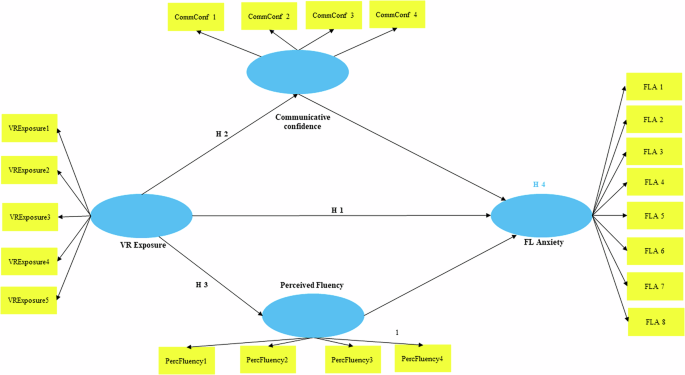
The present study aimed to test a mediational model exploring the impact of VR exposure to learning experiences on Chinese ESL learners’ foreign language anxiety and the mediation role of Communicative Confidence and Perceived fluency in these relationships. Given the present findings, most of the study’s hypotheses have been supported, but several findings deserve further discussion.
H1: VR Exposure and Foreign Language Anxiety
The first hypothesis (H1) results indicated that VR exposure does not significantly predict Foreign Language Anxiety among ESL Chinese learners, as evidenced by the non-significant path coefficient and a high p-value. These findings suggest that, in this study, VR exposure did not directly influence the levels of Foreign Language Anxiety, which contrasts with the findings from several previous studies that have suggested VR may reduce anxiety in language learners (Carlisle et al. 2024; Chung et al. 2024; Park et al. 2023).
For instance, Chen (2024) highlights that technology-enhanced language learning environments, such as VR, can significantly reduce anxiety by providing a low-pressure, immersive environment where learners can practice language skills without the fear of judgment or failure. Similarly, research by Sánchez-Muñoz (2021) found that Second Life, a virtual environment, helped reduce foreign language anxiety in second language learners by allowing them to interact in real-time with native speakers, fostering greater confidence and reducing nervousness.
Despite these promising results from previous studies, the current study’s failure to find significant support for H1 may be attributed to various factors. One possibility is the variation in the type of VR content or the duration of exposure (York et al. 2021). Yudintseva (2023) argues that the degree of immersion and the interactive nature of VR environments are critical in reducing anxiety. If the VR used in this study lacked these immersive features, learners may not fully engage with the content, resulting in minimal impact on their anxiety levels.
Moreover, individual differences among learners, such as previous VR exposure and technological proficiency, could also explain the discrepancy. Lestiono and Lee (2024) noted that VR exposure therapy effectively reduces public speaking anxiety, particularly when learners are familiar with the technology and its use in educational settings. Therefore, a lack of familiarity with VR might have limited its effectiveness for the ESL Chinese learners in this study.
Future research should explore these moderating variables in greater detail, such as the role of technological proficiency and the specific design of VR experiences, to better understand how VR can be optimized to reduce Foreign Language Anxiety. Expanding the sample to include learners with different experience levels with VR may provide deeper insights into its potential benefits in language learning contexts.
H2: VR Exposure and Communicative Confidence
Hypothesis 2 (H2) results provide strong evidence that VR exposure significantly predicts ESL Chinese learners’ Communicative Confidence, with a robust path coefficient and a significant p-value. This supports the hypothesis that VR can be a powerful tool for improving learners’ communication ability in a second language.
The findings align with the work of Reitz et al. (2019), which demonstrated that VR-based gamification of communication training significantly enhances learners’ oral language performance. This suggests that VR’s interactive and immersive nature provides a conducive environment for practicing communication more engagingly and realistically. Similarly, Xie et al. (2021) found that mobile-based VR positively impacted language skills, particularly in facilitating communication and interaction, which are essential components of Communicative Confidence.
Mirzaei et al. (2018) highlighted that VR platforms can simulate real-life conversation scenarios, which allow learners to develop language skills in context, thereby improving their communicative abilities. This corresponds with the current study’s findings, as VR likely provided the learners with opportunities to practice language in a dynamic and context-rich environment, which is critical for building Communicative Confidence.
Moreover, Chang et al. (2012) previously emphasized the role of immersive experiences in language learning, indicating that virtual environments foster deeper engagement with the target language, providing a unique opportunity for learners to engage in meaningful conversations. This further supports the idea that VR can enhance learners’ communication skills by simulating real-world interactions.
To sum up, the significant positive relationship between VR exposure and Communicative Confidence shown in this study reinforces VR’s potential as a valuable tool in ESL education. Future studies could build on these findings by exploring how different types of VR content and interaction modalities affect specific components of Communicative Confidence, such as fluency, accuracy, and pragmatic competence.
H3: VR Exposure and Perceived Fluency
Hypothesis 3 (H3) results confirm a significant relationship between VR exposure and ESL Chinese learners’ perceived fluency, with a strong path coefficient of 0.620 and a p-value of 0.000. This finding indicates that learners exposed to VR felt more fluent in their language abilities. Such results align with the growing body of research on VR’s impact on language learning, specifically regarding fluency development.
Ece et al. (2023) conducted a systematic review highlighting how immersive VR can facilitate significant improvements in foreign language proficiency, particularly fluency. Their review of 21 studies found that students participating in VR-based activities demonstrated enhanced fluency through continuous interaction in realistic scenarios, which likely mirrors the learners’ experience in this study. The immersive nature of VR provides students with opportunities to practice spontaneous speech, reinforcing their perception of fluency.
Similarly, Xie et al. (2021) demonstrated that mobile-based VR positively affected perceived fluency, as it created a low-pressure environment where learners could engage in real-time conversations. The authentic communicative context of VR helps learners gain confidence in their speaking abilities, enhancing their perceived fluency. This matches the current findings, where VR exposure likely fostered a sense of fluency by providing real-world practice opportunities.
Moreover, Xie et al. (2022) found that integrating VR into language teaching programs significantly improved learners’ self-assessment of their language abilities, including fluency. The study showed that learners who engaged in immersive VR sessions felt more confident in their language skills, further supporting the positive relationship observed in this study.
To summarize, the significant positive effect of VR exposure on perceived fluency underscores VR’s potential as an effective tool for developing fluency. Future research should explore how different types of VR environments, task designs, and levels of interaction impact learners’ fluency development over time.
H4: Mediation of Communicative Confidence and Perceived Fluency between VR Exposure and Foreign Language Anxiety
The results of Hypothesis 4 (H4) reveal a significant indirect effect of VR exposure on foreign language anxiety, mediated by both Communicative Confidence and Perceived Fluency. The total indirect effect and significant p-value suggest that while VR exposure does not directly reduce foreign language anxiety, it does so through its positive influence on communicative abilities and perceived fluency.
Yudintseva’s study (2023) suggested that VR-based platforms significantly improved language proficiency, which likely contributed to the enhanced Communicative Confidence and perceived fluency seen in this study. The findings suggest that as learners become more proficient and confident in their communicative abilities through VR interaction, they experience reduced anxiety typically associated with speaking in a foreign language.
Similarly, the results from Hung et al. (2023) align with this conclusion. Their study found that learners engaged in VR-based environments showed improvements in perceived fluency, which in turn helped lower anxiety levels. By practicing in immersive, low-stakes environments, learners could increase their fluency and feel more comfortable communicating in a foreign language, thus decreasing the pressure and anxiety they feel in real-life language situations.
Marandi and Kashanifar (2024) also support this relationship, noting that VR environments provide authentic conversation scenarios that mimic real-world interactions. By improving both perceived fluency and Communicative Confidence, these virtual spaces contribute to learners’ overall language confidence, allowing for anxiety reduction through indirect means, as highlighted by the current study’s findings.
In conclusion, the significant indirect effects of Communicative Confidence and Perceived Fluency emphasize their critical role in mediating the relationship between VR exposure and Foreign Language Anxiety. These findings suggest that future research should focus on understanding the specific elements of VR that best enhance these mediating variables to optimize anxiety reduction.
Limitations of the present study and suggestions for future studies
While providing valuable insights into the relationship between VR exposure, communicative confidence, perceived fluency, and foreign language anxiety among Chinese ESL learners, the present study is not without limitations. These limitations should be acknowledged when interpreting the results and considering directions for future research.
One key limitation is the reliance on self-reported data, which is subject to biases such as social desirability and inaccuracies in self-perception. While the Self-Perceived Communication Competence (SPCC) and other self-assessment scales used in this study are validated tools, participants’ responses may not fully reflect their communicative abilities or fluency (Bensalem 2018). Another limitation of this study is using an ad hoc VR Exposure Scale developed specifically to measure behavioral and attitudinal dimensions of VR engagement in language learning. While the scale demonstrated strong psychometric properties, including a Cronbach’s alpha of 0.845, composite reliability values of 0.858 (rho_A) and 0.889 (rho_C), and an AVE of 0.618, it has not undergone external validation, raising concerns about its generalizability and measurement accuracy. Furthermore, while the scale included items measuring the frequency of specific VR-based activities (e.g., virtual classroom simulations, immersive conversation practice, virtual cultural tours, and virtual language exchange meetups), some terms lacked precise operational definitions. Additionally, data on participants’ familiarity with or prior exposure to these activities were not collected, which may have introduced variability in responses. Future research should aim to validate this scale, refine operational definitions, and assess participants’ familiarity with specific VR activities to enhance reliability and precision in measuring VR exposure in language learning contexts. Future research could benefit from incorporating more objective measures, such as performance-based language assessments, to complement self-reports.
Another limitation relates to the study’s cross-sectional nature, which only provides a snapshot of the relationships between variables at a single point in time. As a result, causal inferences cannot be made. For example, while the study identifies significant relationships between VR exposure and reduced foreign language anxiety, it is unclear whether increased VR exposure leads to lower anxiety or if students with lower anxiety are more likely to engage with VR (Ahlers et al. 2022). Longitudinal studies that track changes over time could provide stronger evidence for causal relationships between these variables.
While the sample was large and diverse in academic disciplines, it was limited to Chinese university students, primarily from Sichuan and Henan Provinces. This geographic and cultural context may limit the generalizability of the findings to ESL learners in other regions of China or globally. Future studies should consider including participants from a broader range of cultural and educational backgrounds to determine whether these findings hold across different contexts (Annamalai et al. 2023).
Another limitation is that the study did not collect data on participants’ prior VR experience or familiarity with VR environments. Differences in previous exposure to VR technology could potentially influence learners’ engagement and the effectiveness of VR as a learning tool. Additionally, the study did not account for participants’ socioeconomic status, which may impact access to VR technology and introduce variability in the generalizability of the findings. Future research should consider these factors to provide a more nuanced understanding of the role of VR exposure in reducing foreign language anxiety and enhancing communicative confidence and fluency.
Additionally, the study focused on specific aspects of VR exposure in language learning, such as frequency and duration and particular activities. However, the quality of the VR experiences, including the type of technology used, the content of the VR activities, and the pedagogical design, was not closely examined. Future research could explore how different types of VR content and instructional approaches influence language learning outcomes, as not all VR experiences may have the same impact (Berns and Reyes Sánchez 2021).
Finally, while the study used advanced statistical techniques such as structural equation modeling (SEM) with SmartPLS, the complexity of human language learning may not be fully captured by the variables examined in this model. Additional variables, such as motivation, learning strategies, and previous exposure to foreign languages, could further enrich the understanding of how VR influences language learning outcomes (Bai 2023).
Suggestions for ESL teachers
Based on the findings of this study, several recommendations emerge for ESL teachers looking to incorporate VR technology into their teaching practices to reduce Foreign Language Anxiety (Foreign Language Anxiety) and enhance students’ Communicative Confidence and perceived fluency.
One of the key takeaways is the potential for VR to create low-stress learning environments. ESL teachers should consider using VR to provide immersive, engaging spaces where learners can practice language skills without the pressure of real-world judgment. VR can simulate real-life conversations and scenarios, allowing students to experiment with language in a way that builds their confidence and reduces anxiety. Studies have shown that learners who practice in these low-stakes environments, such as those by Yudintseva (2023) and Hung and Chien (2023), experience reduced anxiety levels because they feel more at ease using the language in authentic situations (Cai et al. 2024).
In addition, teachers can use VR as a tool to focus on fluency development through repetition and immersion. By frequently exposing students to communicative tasks in a virtual world, learners can improve their perceived fluency, which, as demonstrated by this study, indirectly reduces anxiety. The use of VR to simulate everyday interactions helps students practice language in varied contexts, enhancing their ability to use it more fluidly and confidently (Cho 2018). However, while it is important to prioritize fluency, teachers should ensure that VR-based language learning also addresses other aspects of language, such as accuracy and grammar (Chen and Wang 2024). As Marandi and Kashanifar (2024) suggested, VR can replicate real-life conversations, but it is still the teacher’s role to provide corrective feedback and reinforce correct language use.
Moreover, the teacher’s presence and support are crucial in maximizing VR’s benefits for reducing anxiety. A supportive teacher who provides timely feedback, encouragement, and guidance can help learners feel more comfortable and confident during VR-based activities (Perry 2023). Teachers should monitor learners closely during these sessions, offering constructive feedback and positive reinforcement to reduce anxiety further and improve Communicative Confidence (Guan et al. 2024).
Finally, teachers should be mindful of balancing explicit and implicit knowledge in their instruction. While VR facilitates implicit learning by focusing on communication and meaning, teachers must integrate explicit language instruction where required. This balanced approach ensures that students improve their fluency and understanding of language structures (Croucher et al. 2024). Gradually introducing VR into the classroom and evaluating its effectiveness over time will help teachers ensure that the technology complements, rather than replaces, traditional language learning methods (Hsu 2024). Incorporating VR in a thoughtful and supportive manner can significantly reduce Foreign Language Anxiety and boost students’ Communicative Confidence and fluency, making it a valuable tool for ESL educators.
link